Venus: An Efficient Edge Memory-and-Retrieval System for VLM-based Online Video Understanding
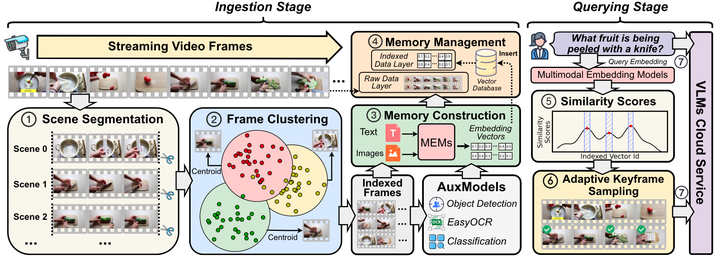 Venus Overview
Abstract
Vision-language models (VLMs) have demonstrated impressive multimodal comprehension capabilities and are being deployed in an increasing number of online video understanding applications. While recent efforts extensively explore advancing VLMs’ reasoning power in these cases, deployment constraints are overlooked, leading to overwhelming system overhead in real-world deployments. To address that, we propose Venus, an on-device memory-and-retrieval system for efficient online video understanding. Venus proposes an edge–cloud disaggregated architecture that sinks memory construction and keyframe retrieval from cloud to edge, operating in two stages. In the ingestion stage, Venus continuously processes streaming edge videos via scene segmentation and clustering, where the selected keyframes are embedded with a multimodal embedding model to build a hierarchical memory for efficient storage and retrieval. In the querying stage, Venus indexes incoming queries from memory, and employs a threshold-based progressive sampling algorithm for keyframe selection that enhances diversity and adaptively balances system cost and reasoning accuracy.
Shengyuan Ye
Ph.D. student at SMCLab
He is a Ph.D. student at School of Computer Science and Engineering, Sun Yat-sen University. His research interests include Resource-efficient AI Systems and Applications with Mobile AI.
Liekang Zeng
Ph.D., Sun Yat-sen University
He obtained Ph.D. degree at School of Computer Science and Engineering, Sun Yat-sen University. His research interest lies in building edge intelligence systems with real-time responsiveness, systematic resource efficiency, and theoretical performance guarantee.

Mu Yuan
Ph.D., USTC
He received PhD degree from University of Science and Technology of China in 2024, advised by Prof. Xiang-Yang Li and Prof. Lan Zhang. He was a postdoctoral fellow at CUHK, working with Prof. Guoliang Xing.His research interest lie in designing theory-backed algorithms and building innovative systems for AI workloads.
Xiaowen Chu
Professor, HKUST(GZ)
Acting Head, Data Science and Analytics Thrust
Dr. Chu is currently a Professor at the Data Science and Analytics Thrust, Information Hub of HKUST(GZ), and an Affiliate Professor in the Department of Computer Science and Engineering, HKUST. His current research interests include GPU Computing, Distributed Machine Learning, Cloud Computing, and Wireless Networks. He is especially interested in the modelling, parallel algorithm design, application optimization, and energy efficiency of GPU computing.

Xu Chen
Professor and Assistant Dean, Sun Yat-sen University
Director, Institute of Advanced Networking & Computing Systems
Xu Chen is a Full Professor with Sun Yat-sen University, Director of Institute of Advanced Networking and Computing Systems (IANCS), and the Vice Director of National Engineering Research Laboratory of Digital Homes. His research interest includes edge computing and cloud computing, federated learning, cloud-native intelligent robots, distributed artificial intelligence, intelligent big data analysis, and computing power network.